
Bench Warrants in Kandiyohi County
A bench warrant is a judge's tool. It brings a person before the court or enforces the court's process after noncompliance, and it is not a new charge or a probable-cause arrest warrant filed with a fresh complaint. Kandiyohi County's public list skips a bench-warrant type column and uses short reason labels instead. A row marked failure to appear, contempt of court, or probation violation is the kind of entry that most often reflects a missed court obligation. Read the label, then ask the court behind it. The case file tells the rest of the story.
No Capias Pro Fine in Kandiyohi Warrants
People who have read other states' warrant pages often ask about a capias. Minnesota's official sources do not use capias pro fine as the ordinary label for a failure-to-appear or fine-collection writ. Instead, Kandiyohi County's court and Sheriff materials use arrest warrant, bench warrant, failure-to-appear warrant, and warrant for violation of release conditions. That distinction is practical, not trivia, because the label drives the route. An unpaid fine belongs with the Court Payment Center. A missed appearance belongs with the District Court case. Match the wrong word to the wrong office in Kandiyohi County, and you may end up at a counter that cannot help with an active warrant at all.
How a Bench Warrant Is Issued in Kandiyohi County
Minnesota Rule of Criminal Procedure 3 governs the summons-or-warrant choice a district judge makes when a complaint is filed. A summons is the ordinary path. A warrant issues only when the rule's conditions are met, and Rule 3 also requires a warrant when a defendant fails to appear in response to a summons. The same rule spells out the contents: the person's identity or description, the offense, the bail amount, and any release conditions. Once a Kandiyohi County case is underway, a missed hearing or a failure to obey a court order can lead the judge to issue an order to appear. That order carries the same effect as a bench warrant. Minnesota Rule of Criminal Procedure 3 sets out the summons-or-warrant decision and the required contents of the order.
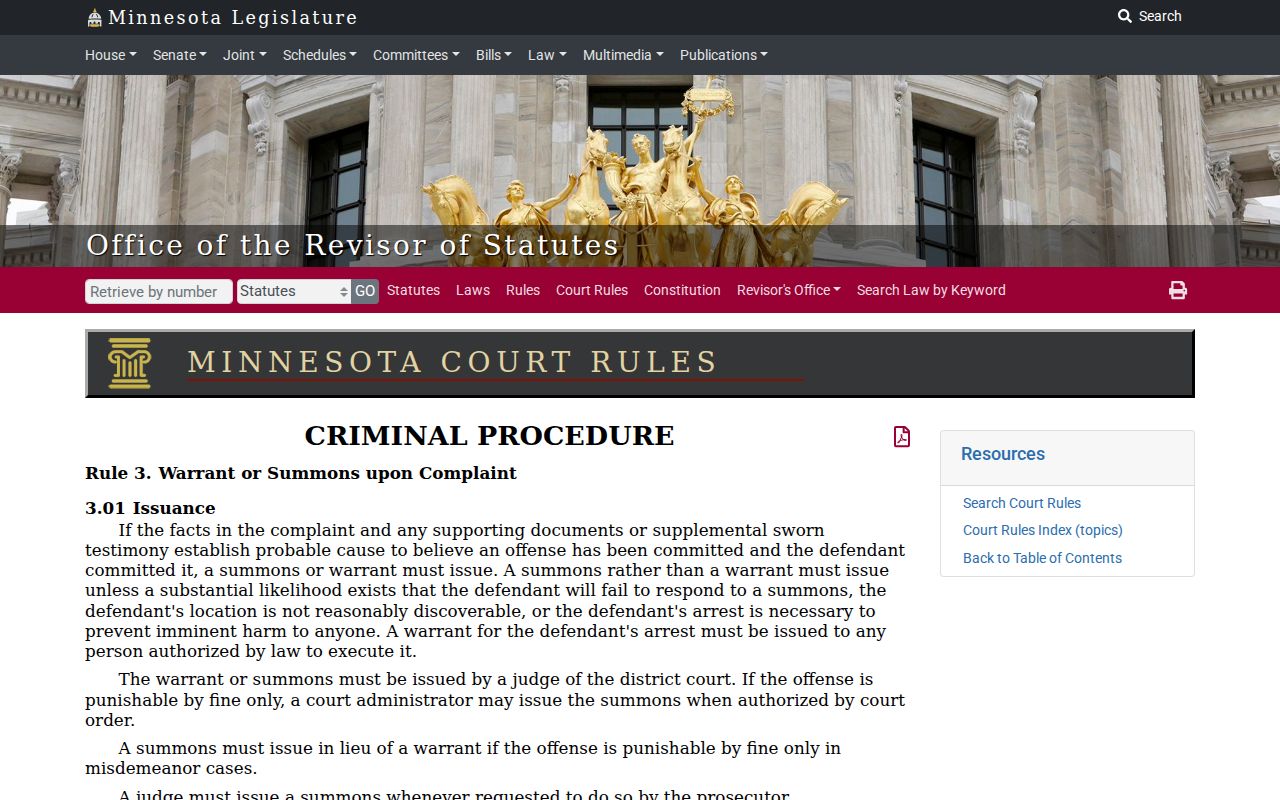
Rule 3 is what turns a missed court obligation into a Kandiyohi County warrant.
Kandiyohi County Bench Warrant Labels
The Kandiyohi County list compresses each warrant's reason into a few words. Treat those labels as a starting point, since every one points to a different question for the issuing court.
- Failure to appear (FTA)
- A missed hearing or a missed response to a summons; ask the court for the new date or motion the judge requires.
- Contempt of court
- An order-violation label; the court file and the judge's order identify what must happen next.
- Probation violation
- An alleged supervision violation; the remedy is usually a hearing, not a fine payment.
- Condition release violation
- An alleged breach of a release condition; the underlying order supplies the actual terms.
Bench Warrant vs Arrest Warrant
A Kandiyohi County bench warrant and an arrest warrant can both end in an arrest, so the difference is easy to miss. What separates them is the trigger and the case posture. The public list row often does not say which one applies, so ask the court.
| Point | Bench or Failure-to-Appear Warrant | Probable-Cause Arrest Warrant |
|---|---|---|
| What triggers it | A missed appearance or court-order noncompliance | Probable cause in a complaint or indictment |
| Who issues it | The district judge handling the case | The district judge who reviews the complaint |
| Typical first fix | A new court date, a motion, or an appearance before the judge | Identifying the case and the release terms, often through counsel |
| Where it appears | A short list description and the case Register of Actions | The same list, plus the complaint and case file |
Questions About a Kandiyohi County Bench Warrant
Court administration in Kandiyohi County is a routing and records office, not a judge. It cannot recall a warrant on its own. It can still answer the practical questions a caller needs, so have details ready: the person's full name, date of birth, case or citation number, and the missed date if known.
- Which case produced the warrant or flag?
- Does the judge require a motion, a hearing, or a personal appearance?
- Is a bond or release condition involved, and what does the current order say?
- How should the person confirm the status after the court acts?
Note: A clerk can explain the record and the process, but only the judge can recall, quash, or otherwise clear the warrant.
How to Resolve a Kandiyohi County Bench Warrant
Resolution starts with the case file, not the list. Search the county active warrant listing and Minnesota Court Records Online, open the Register of Actions to find the case behind the flag, then ask the court what it requires. Kandiyohi County posts no public motion-to-recall form, no walk-in surrender hours, and no bond window. Call before you visit.
- Search the county list and MCRO, and record the case number behind the flag.
- Call Kandiyohi County District Court at 320-231-6206 and ask what the judge requires.
- Talk to a licensed Minnesota attorney about a motion, a hearing, or a coordinated appearance.
- Call the Sheriff's Office records desk at 320-214-6700 ext. 2 before going to the LEC.
- After the judge acts, keep the order and confirm that the record and list caught up.
Caution: A missed appearance can add new court action and release conditions, and only the issuing judge can clear the warrant.
Traffic Appearance Warrants in Kandiyohi County
A traffic case can produce a Kandiyohi County bench warrant too. A missed traffic date is not the same as an unpaid payable ticket. The Minnesota Court Payment Center handles payments and citation questions, and the Judicial Branch warns that failure to pay or appear can lead to a warrant, late penalties, and other consequences. Only the court can say whether a hearing is required. Start with the citation or case number. Describe the problem as a missed date, and ask whether a warrant already exists. Never mail a payment as a substitute for a required appearance in Kandiyohi County court.
Which Kandiyohi County Court Issued It
Kandiyohi County runs one trial court, not a stack of municipal courts. The official court page says the Kandiyohi County District Court holds original jurisdiction over every criminal, traffic, civil, family, probate, and juvenile case filed in the county. The county has no separate justice-of-the-peace court, no municipal-court warrant portal, and no city court counter. The Eighth Judicial District administration at 505 Becker Avenue SW, Suite 107, reachable at 320-231-6570, is an administrative contact, not a second trial court. City police departments in Kandiyohi County can issue or serve process. But the judge who issues a bench warrant sits in the district court, and that is where questions about an outstanding warrant go.
Kandiyohi County Family and Juvenile Warrant Limits
Some Kandiyohi County bench-warrant questions stay closed to the public. Family, child-support, and juvenile cases sit in district court, but the access rules differ from adult criminal matters. Juvenile records face limits on public inspection. The courthouse calendar leaves confidential and non-remotely-accessible events off its list, so a warrant in those cases will not surface there.
Key Rules:
Minnesota Statutes section 260B.171 - juvenile records are not open to ordinary public inspection, so a juvenile warrant will not appear in the adult list.
Minnesota Statutes section 13.82 - arrest-warrant-index data can stay confidential before custody, service, or appearance.
Kandiyohi County District Court - the court's family and juvenile divisions route these questions; ask which division holds the file.