
Arrest Warrants in Kandiyohi County
An arrest warrant in Kandiyohi County is a judge-signed order that lets an officer take a named person into custody on a stated offense. A probable-cause review comes first. That review is one of several things a charging decision can produce. The county's public warrant list may show a row with an offense level and a short description. What it never shows is who issued the warrant or which agency will serve it. Those two answers live in the case file. The agencies named there hold them, so the list is only where a Kandiyohi County warrant search starts.
Rule 3 and Kandiyohi County Arrest Warrants
Minnesota Rule of Criminal Procedure 2 governs the complaint itself. The complaint needs a signed statement of the offense, the statute cited, the maximum penalty, and enough facts to establish probable cause. Sworn testimony or supporting affidavits may fill the gaps. A district judge reviews all of it before any process issues. Rule 3 then says what the judge may issue. It requires either a summons or a warrant, sets the conditions that make a warrant appropriate, and spells out what the warrant itself must state. Two more rules finish the picture in Kandiyohi County: Rule 4 governs the procedure after an arrest, while Rule 19 covers warrants or summonses issued on an indictment.
Warrant flow: Complaint and probable cause review › summons or warrant decision › service by an authorized officer › first appearance and release conditions.
What a Kandiyohi County Arrest Warrant Contains
Rule 3.02 sets the required contents. The warrant must identify the person, state the offense, and give the bail amount and any release conditions. Kandiyohi County's public list shows only a slice of that structure. The court file holds the rest.
| Warrant Number | The row identifier, in formats that vary by age; recent entries are ten-digit date-like identifiers, such as 10-digit date-like ID. |
|---|---|
| Case Number | The court file identifier that links the warrant to the case, which the county list does not show. |
| Offense | The charge and its offense level, with a short description on the public list. |
| Issuing Judge or Court | The judicial authority behind the order, found in the case file rather than the list. |
| Bail and Release Conditions | Judicial terms stated on the warrant and confirmed through the court order. |
| Execution and Status | Service and clearance information held by the court and the serving agency. |
Why Kandiyohi Warrants Start With a Summons
A filed complaint does not mean a warrant follows automatically. Minnesota Rule 3.01 makes a summons the ordinary process. A warrant issues only when the rule's conditions apply: a substantial likelihood the person will not respond, an unknown location, a risk of harm, or a failure to appear after a summons was served. That preference explains a gap people often miss in Kandiyohi County. A person can have a charge on file and no warrant at all. Someone else may hold a summons that has gone unanswered. The warrant list cannot tell you which situation you are looking at. The courthouse calendar and the case file can.
Note: A filed charge and an issued warrant are different events, and only the case file shows which one has happened.
How Kandiyohi County Arrest Warrants Are Served
Rule 3 directs a warrant to a person authorized by law to execute it. In Kandiyohi County that may be a Sheriff's deputy, a city police officer, or another authorized peace officer. Service can happen at a traffic stop. It can happen at a residence or after a coordinated investigation. The county list has no serving-agency column, so nothing on it predicts which officer shows up. After an arrest on a warrant, the person must go before a judge as the warrant directs, without unnecessary delay. When the issuing court is not in session, Rule 3 generally requires presentation within 36 hours after the arrest, not counting the day of arrest. The judge then reviews bail and release conditions. Those are judicial decisions in Kandiyohi County, not county schedule items.
The Kandiyohi County Warrant Service Map
Serving a warrant is a service role. It does not make an agency the issuing court. The agencies below are the verified Kandiyohi County contacts, and each one answers a different question.
| Agency | Verified Role | Contact |
|---|---|---|
| Kandiyohi County Sheriff's Office | County law-enforcement records, active list, and warrant service | 320-235-1260 |
| Willmar Police Department | City police agency that may serve warrants and hold citation provenance | 320-235-2244 |
| Atwater Police Department | City police contact, with county dispatch for wider routing | 320-974-8900 |
| New London and Raymond | Police service contracted or routed to the county Sheriff's Office | 320-235-1260 |
| Kandiyohi County District Court | Judicial issuance, case records, and release conditions | 320-231-6206 |
Arrest Warrant vs Summons vs Bench Warrant
In a case summary the three documents look alike, yet they behave differently in practice. The trigger and the court's posture are the quickest way to tell a Kandiyohi County arrest warrant, a summons, and a bench warrant apart.
| Point | Summons | Arrest Warrant | Bench Warrant |
|---|---|---|---|
| What it does | Orders a court appearance | Authorizes custody on a charge | Enforces the court's appearance or compliance order |
| When it issues | At the complaint stage, as the ordinary process | When Rule 3 conditions are met | After a missed appearance or noncompliance |
| First place to look | The case file and the court | The case file, then the county list | The case Register of Actions |
| Typical first step | Appear as ordered or contact counsel | Contact counsel and ask the court about release terms | Ask the court what motion, date, or appearance it requires |
The 36-Hour Rule for Kandiyohi County Warrants
Rule 3.02 and the related arrest procedure demand a prompt first appearance. The warrant directs that the person be brought before a judge without unnecessary delay. When the issuing court is not in session, that presentation generally comes no later than 36 hours after the arrest, excluding the day of arrest. The clock is firm. What it is not is a release promise. Release turns on the judge's review of the case, the bail amount, and any conditions. So read the 36-hour rule in Kandiyohi County as a timing rule only, never as a way to predict an outcome.
Caution: The 36-hour rule governs when a person must see a judge, not whether the person will be released or what the bail will be.
What to Do If There Is a Warrant for You
Talk to a licensed Minnesota attorney first. An attorney can find the case, explain the release terms, contact the court, and arrange a lawful appearance. Kandiyohi County publishes no pre-arrest walk-through protocol, no bond schedule, and no walk-in surrender hours, so do not assume a counter at the Law Enforcement Center exists. The lawful options are an appearance arranged with counsel, a bond set by the judge, or a motion the court accepts. Each begins with the case number. Call court administration at 320-231-6206. Before any visit, call the Sheriff's Office records desk at 320-214-6700 ext. 2. Check both public channels first. The county active warrant listing shows whether a row exists. Minnesota Court Records Online shows the case behind it. Neither one is complete.
Important: An active arrest warrant can lead to custody at any contact with law enforcement, so speak with a lawyer before making any plan to turn yourself in.
Federal Warrants and Kandiyohi County Records
Federal warrants follow a different track from anything in Kandiyohi County's own records. The county sits inside the U.S. District Court for the District of Minnesota, which holds court in Minneapolis, St. Paul, Duluth, and Fergus Falls. A federal judge or magistrate signs a federal warrant. The U.S. Marshals Service, with partner agencies, then serves it. None of that touches a Kandiyohi County warrant search, which covers local active warrants only, and an out-of-state warrant stays the business of the state that issued it. For federal fugitive work, the U.S. Marshals District of Minnesota page lists the district offices, and its North Star Fugitive Task Force covers Kandiyohi County. To read a federal docket, you go through PACER. It charges 0.10 dollars a page, caps most documents at 3 dollars, and waives fees when quarterly use is 30 dollars or less. The fee page spells out those costs before a search begins.
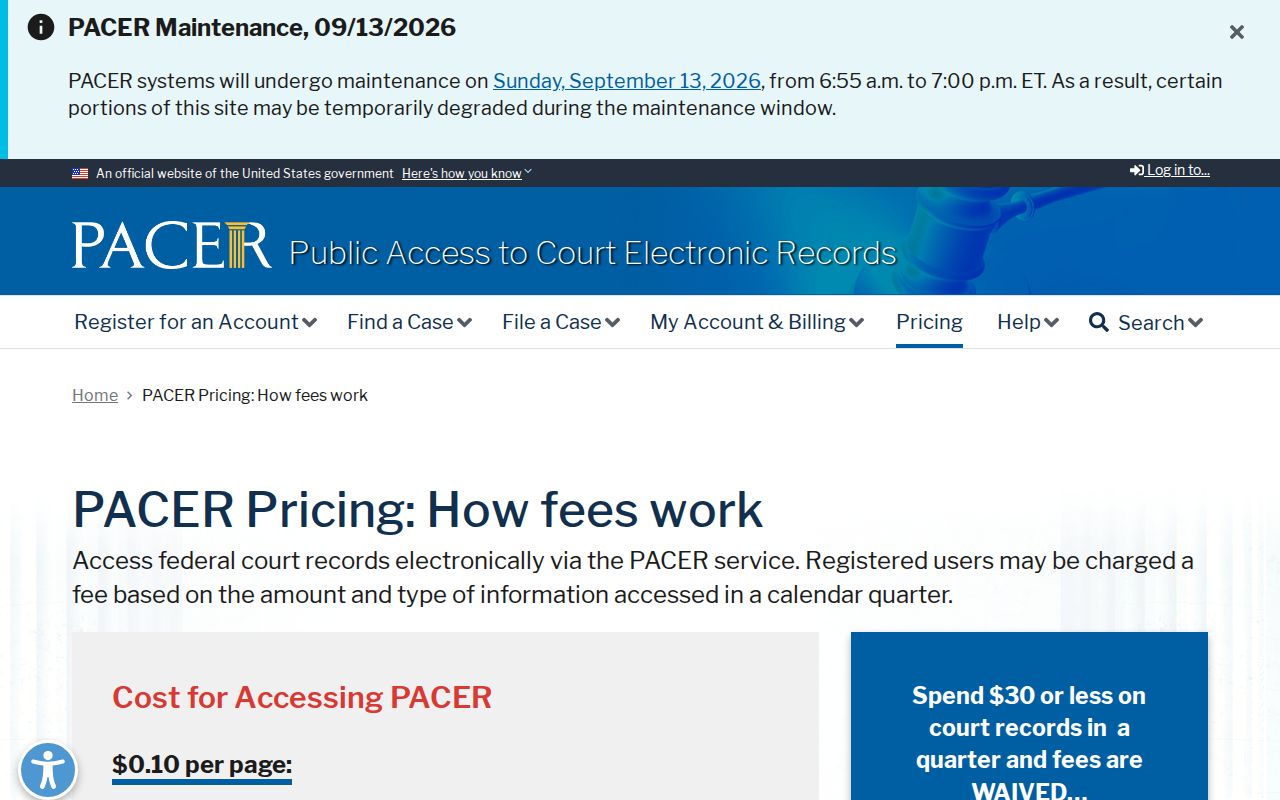
Kandiyohi County readers can check the PACER fee page to see what a federal docket search costs.